

In the digital age, more and more companies are moving their IT infrastructure to the cloud. The move brings many advantages, including better scalability, flexibility and access to advanced technologies. However, one of the main concerns for organizations is the cost of cloud migration. Google Cloud, a leading cloud provider, offers a range of cost-effective options that can significantly reduce expenses while maximizing the benefits of cloud computing.
Understanding Cloud Migration
Cloud migration involves relocating data, applications, and core services from on-premises infrastructure to a scalable cloud environment. The process requires careful architectural planning to ensure minimal disruption to business operations. Key motivations for cloud migration include:
The Cost Factor in Cloud Migration
While the strategic advantages of cloud migration are clear, cost management remains an essential concern for leadership. Traditional on-premises setups require heavy capital expenditure (CapEx) upfront. In contrast, cloud computing shifts infrastructure to an operational expenditure (OpEx) model, where businesses pay only for consumed capacity.
Without proper governance, unmonitored cloud spending can lead to budget surprises. This is where Google Cloud Platform (GCP) distinguishes itself through automated discounts, intelligent rightsizing, and flexible resource pricing.
Google Cloud's Cost-Effective Solutions
Google Cloud provides a number of pricing models and tools that help companies manage and reduce costs effectively:
1. Pay-As-You-Go Pricing Model
Google Cloud's pay-as-you-go pricing model ensures that organizations only pay for the exact compute, storage, and networking resources they consume with per-second billing. This design eliminates heavy upfront capital investments and empowers companies to scale resource usage up or down according to real-time production requirements.
2. Sustained Use Discounts (SUDs)
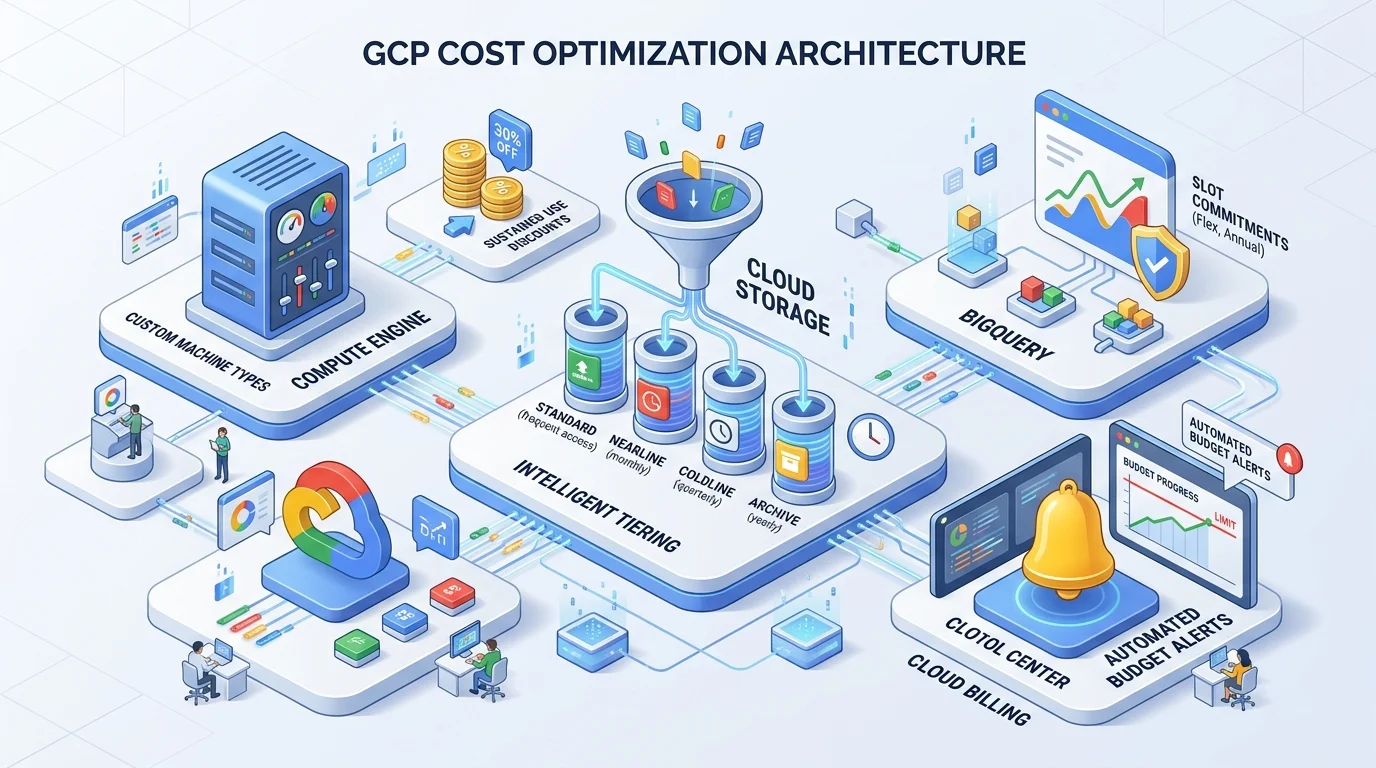
Google Cloud automatically provides Sustained Use Discounts (SUDs) for Compute Engine instances that run for a significant portion of the billing month. Unlike other clouds that require manual intervention, Google automatically applies discounts of up to 30% on compute workloads that run consistently without requiring upfront long-term commitments.
3. Committed Use Discounts (CUDs)
For organizations with predictable baseline workloads, Google Cloud offers Committed Use Discounts (CUDs). By committing to a specific volume of compute cores, RAM, or spend over a 1-year or 3-year term, companies can secure massive savings of up to 57% for standard VM workloads and up to 70% for memory-optimized machines.
4. Spot VMs & Preemptible VM Instances
Google Cloud Spot VMs (the evolution of Preemptible VMs) provide excess compute capacity at discounts of 60% to 91% compared to standard on-demand rates. Spot VMs are ideal for fault-tolerant batch processing, big data analysis, CI/CD runners, and containerized workloads managed by Google Kubernetes Engine (GKE).
5. Rightsizing Recommendations
Google Cloud's built-in recommendation engine analyzes your usage patterns and suggests rightsizing opportunities. By adjusting the size of your virtual machines and other resources, you can avoid over-provisioning and make sure you are not paying for more capacity than you need.
6. Storage Classes and Lifecycle Management
Google Cloud offers several storage classes, including Standard, Nearline, Coldline and Archive, each designed for different access patterns and storage needs. By choosing the right storage class and using lifecycle management policies to move data automatically to cheaper tiers, companies can optimize their storage costs.
7. Network Service Tiers
Google Cloud offers tiered networking options (Premium and Standard), allowing organizations to balance network performance against bandwidth expenditure.
Case Studies: Cost Savings with Google Cloud:
Best Practices for Cost-Effective Cloud Migration
To maximize cost savings during and after migration to Google Cloud, organizations should adhere to these best practices:
1. Conduct a Thorough Assessment
Before migrating, carry out a detailed analysis of your existing infrastructure, applications and workloads. Identify which components are suitable for the cloud and estimate the likely costs and savings.
2. Develop a Comprehensive Migration Plan
Create a detailed migration plan with timelines, milestones and resource requirements. A well-structured plan helps minimize disruption and ensures a smooth transition to the cloud.
3. Use Automation Tools
Use Google Cloud's automation tools, such as Cloud Deployment Manager and Cloud Build, to streamline the migration. Automation reduces manual work, cuts down on errors and shortens the migration timeline.
4. Monitor and Optimize Usage
Continuously track your cloud usage and costs with Google Cloud's monitoring and billing tools, such as Cloud Monitoring (formerly Stackdriver) and Cloud Billing reports. Review usage patterns regularly and apply optimizations so you are not overspending.
5. Train Your Team
Invest in training your team to manage and optimize cloud resources effectively. Google Cloud offers a range of training programs and certifications to help your team keep up with best practices and new features.
Migrating to the cloud is a strategic move with many benefits, including cost savings, scalability and access to advanced technologies. Google Cloud offers a range of cost-effective options that help businesses control spending while getting the most out of cloud computing. By using pay-as-you-go pricing, sustained use discounts, committed use discounts and other cost-saving strategies, businesses can achieve an affordable cloud migration that supports their growth goals.
By following best practices and using Google Cloud's comprehensive set of tools and services, businesses can ensure a smooth, cost-effective migration and unlock the full potential of cloud computing while keeping costs under control.