
Back to all blogs
Software Development

Beyond Monoliths: Why Odoo is the Smartest ERP Choice for Modern, Scalable Enterprises

REEA Digital Team7 min read
Share:
Beyond Monoliths: Why Odoo is the Smartest ERP Choice for Modern, Scalable Enterprises

It can be difficult to choose the best ERP solution for your business in the quickly changing world of enterprise software. Where legacy ERP systems like SAP, Oracle NetSuite, and Microsoft Dynamics 365 often demand huge budgets, long implementations, and armies of consultants, Odoo flips that model on its head with an open, modular, and affordable approach.

It can be difficult to choose the best ERP solution for your business in the quickly changing world of enterprise software nowadays. SAP, Oracle NetSuite, Microsoft Dynamics 365, and Odoo are just a few of the many options available to decisionmakers. But because of its ease of use, versatility, and robust all-in-one feature set, Odoo has been increasingly popular among both small businesses and large enterprises in recent years. Where legacy ERP systems often demand huge budgets, long implementations, and armies of consultants, Odoo flips that model on its head with an open, modular, and affordable approach.

Odoo is a tempting solution for every kind of organization, be it a startup trying to streamline its sales pipeline or a major corporation trying to unify your entire operations under one roof. We will examine the advantages of Odoo in this post and discuss why it can be the best option for your upcoming project.

1. Understanding Odoo

Understanding Odoo is crucial before delving into its advantages. Odoo is an open-source suite of integrated business applications used to manage everything from sales and inventory to accounting, manufacturing, human resources, and eCommerce. It was created by Fabien Pinckaers and first released in 2005 (originally as TinyERP, then renamed OpenERP, and finally rebranded as Odoo in 2014). Since then, Odoo's popularity has increased because of its modular design, ease of integration, and lightweight, web-based architecture. Odoo provides an approach to running a business that is more flexible and modular than frameworks like SAP or Oracle, which adhere to a rigid, monolithic structure.

●Integrated Suite: By connecting dozens of business apps that all share a single PostgreSQL database, Odoo lets information flow freely between departments without manual re-entry or clunky middleware.
●Component-Based (Modular) Architecture: Because Odoo is composed of reusable, installable modules, managing and scaling large deployments is made simpler. You enable only the apps you need and add more over time.
●Reactive, Real-Time Data: Odoo makes operations faster and more intuitive by dynamically updating records across every connected app at the moment the underlying data changes.

2. Built on Python: The Technical Foundation

A major reason Odoo is so powerful yet approachable is its technology stack. The backend is written in Python, one of the world's most popular, readable, and widely supported programming languages, while the frontend uses the modern OWL (Odoo Web Library) JavaScript framework, with business logic and views defined through XML and data stored in PostgreSQL.

●Python-Powered Backend: Because Odoo's core and all its modules are written in Python, there is a massive global talent pool of developers who can read, extend, and customize it. Compared to SAP's proprietary ABAP language, which requires rare and expensive specialists, Python makes Odoo development faster, cheaper, and far more accessible.
●ORM Instead of Raw SQL: Odoo ships with its own Object-Relational Mapping (ORM) layer, so developers define business models as Python classes (models.Model) and fields (fields.Char, fields.Many2one, fields.One2many) rather than writing raw SQL. This dramatically reduces boilerplate and keeps the data layer clean and consistent.
●QWeb Templating and OWL: Odoo uses the QWeb template engine for reports and web pages and the OWL framework for a snappy, modern user interface, giving you dynamic, component-driven screens without a full page reload.
●Open and Extensible: The entire framework is open source, so you can inherit from and extend existing models (_inherit) to add fields or change behavior without ever touching the core, keeping your customizations safe through upgrades.

3. A Gentle Learning Curve

Odoo's low learning curve is a major factor in its growing popularity. When it comes to ERP platforms, Odoo is frequently far easier for teams to adopt than heavyweight options like SAP S/4HANA or Oracle NetSuite.

●Simple, Modern Interface: Even employees who have never used an ERP may easily understand Odoo's clean, app-like dashboards and menus. Odoo lets businesses get productive more quickly by reducing the training overhead that legacy systems demand.
●Outstanding Documentation and Learning: Among ERP platforms, Odoo has some of the most thorough and elegantly written documentation. The official docs, free Odoo eLearning courses, and video tutorials offer concise explanations, examples, and best practices that make learning Odoo simple for administrators and end users at all skill levels.
●Gradual Adoption: Odoo enables gradual implementation. This implies that you don't have to migrate your entire business at once; instead, you can begin by rolling out one small part such as CRM or Sales and work your way up to accounting, inventory, and manufacturing.

When it comes to onboarding new staff or switching from a patchwork of older tools, Odoo is a great option because it's simple for people with ordinary computer skills (working with email, spreadsheets, and web apps) to get up to speed.

4. Flexibility and Versatility

Odoo is uniquely flexible when compared to other ERP systems. Odoo may be used for a variety of needs, from a single-app deployment for a small shop to a huge, fully integrated platform running an entire enterprise, because of its versatility and adaptability.

●One App or an Entire Suite: The best platform for growing step by step is Odoo, which allows you to start with a single module and expand without re-platforming. You handle one department today and add the rest whenever you're ready.
●Any Industry, Any Size: Business applications that fit retail, manufacturing, services, logistics, healthcare, and more can be built with Odoo. Developers and partners can easily tailor Odoo to niche industries using their studio tools and custom modules.
●Configuration-Driven Development: Because Odoo is modular, businesses may divide their operations into manageable, reusable apps that can be combined and rearranged across departments. As a result, the system is easier to maintain and more adaptable.

Instead of being forced into a specific, rigid process, Odoo gives organizations the flexibility to structure the system based on real-world needs because it can be adjusted to many use cases. Whether you're running a SaaS company, an e-commerce brand, or a factory floor, Odoo can easily integrate into your workflow.

5. The Core Modules and Why They Matter

Odoo's real strength shows up in its individual business apps. Each module is powerful on its own, yet all of them share the same database, so data flows seamlessly between them. Here are the key modules, the technical concepts behind them, and why they outperform the alternatives.

●Sales and CRM: The Odoo CRM app manages your pipeline with drag-and-drop opportunity stages, lead scoring, and automated follow-up activities. The Sales app turns a confirmed quotation into a sales order, which automatically triggers delivery orders and invoices downstream. Features like configurable quotation templates, electronic signatures, and customer portals shorten the sales cycle. Compared to Salesforce bolted onto a separate ERP, Odoo's CRM and Sales live inside the same system, so there's no fragile integration between your pipeline and your invoicing.
●Inventory and Warehouse: Odoo Inventory is built on a modern double-entry inventory model, the stock equivalent of double-entry accounting, where goods always move from one location to another rather than simply appearing or disappearing. It supports multi-warehouse management, lot and serial number tracking, barcode scanning, put away and removal strategies (FIFO, LIFO, FEFO), reordering rules, and advanced routes like drop-shipping and cross-docking. This gives you real-time, fully traceable stock, something that often requires costly add-ons in SAP or NetSuite.
●Accounting and Finance: The Accounting app offers true double-entry bookkeeping, multi-currency and multi-company support, automated bank reconciliation with AI-assisted matching, tax configuration for different countries, and analytic accounting for cost tracking. Invoices generated from Sales post automatically to the general ledger, eliminating duplicate entry. Where SAP and Oracle charge premium licensing for comparable finance capability, Odoo delivers it as part of the integrated suite.
●Human Resources (HR): The HR suite covers Employees, Recruitment, Time Off, Attendances, Appraisals, Expenses, and Payroll. Technical touches like approval workflows, employee self-service portals, and integration with Timesheets and Projects mean HR data connects directly to payroll and project costing. Instead of running a separate standalone HR system that must be synced, Odoo keeps your people's data in the same platform as the work they do.
●Manufacturing (MRP): Odoo Manufacturing handles Bills of Materials (BoM), Work Orders, Work Centers, and routings, with support for Material Requirements Planning (MRP), subcontracting, quality control checkpoints, and Product Lifecycle Management (PLM). Real-time shop-floor control and barcode-driven work orders give manufacturers visibility that typically costs a fortune in traditional ERP deployments.
●Website and eCommerce: Odoo includes a drag-and-drop website builder and a fully integrated online store. Because eCommerce shares the same product catalog, stock, and customer records as the rest of Odoo, an online order updates inventory and accounting instantly, with no third-party connector required.

6. All-in-One Integration

Real-time, cross-app integration is a prominent component of Odoo. This feature makes sure that, without the need for manual data transfer, any change made in one app is immediately reflected across every connected app and department.

Businesses rely on a single shared database so that a record created in Sales is instantly visible in Inventory, Accounting, and Reporting. There is no need for nightly syncs or brittle connectors; the data is unified by design.
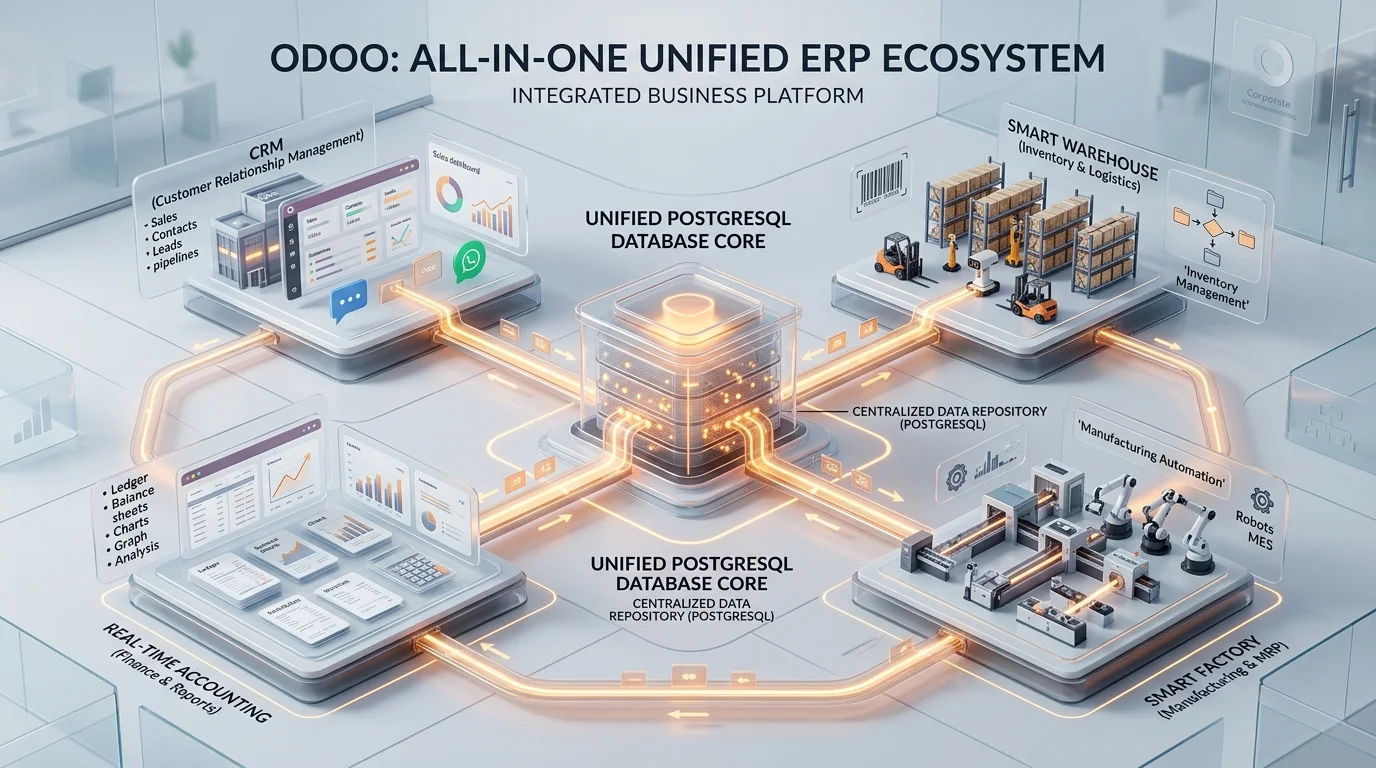
Odoo All-in-One Unified ERP Ecosystem: Centralized PostgreSQL Database connecting CRM, Smart Warehouse, Real-time Accounting, and Smart Factory

The integrated architecture built into Odoo is effective; it ensures that only the relevant records are updated and that every team sees the same accurate information.

●Faster Operations: Time is saved, and errors are decreased when staff don't have to re-key the same information into separate systems or reconcile mismatched spreadsheets.
●A Single Source of Truth: Operations that respond instantly to new data feel more connected and reliable, giving leadership a clearer, real-time picture of the business.

Consider that a customer confirms a large order in the Sales app. With Odoo, stock levels drop automatically in Inventory, a delivery order is created for the warehouse, an invoice is generated in accounting, and the dashboard updates in real time, all from a single action. An operation that is more responsive and reliable is ensured by this unified system.

7. Component-Based Modular Architecture

Because Odoo is based on a modular architecture, businesses may build their system by assembling separate, reusable modules. Cleaner processes, better maintainability, and easier collaboration between teams are the results of this design philosophy.

In essence, modules are self-contained units of business functionality that combine data models, logic, and user interface. A module in Odoo can be as basic as a small feature add-on or as sophisticated as a complete manufacturing management system, and modules are reusable and extensible across the platform.

●Reusability and Inheritance: Through Python inheritance (_inherit) and view inheritance in XML, modules can be extended and customized repeatedly without duplicating code. This guarantees consistency while cutting down on development time.
●Maintenance Ease: Since modules are self-contained, developers may focus on one area of the business without having to worry about the system as a whole. This simplifies the process of managing updates and fixing issues.
●Scalability: The platform may expand without adding complexity as the business grows, since modules are easily added, extended, or adjusted.

For instance, you could install only Point of Sale and Inventory for a small retail launch, then later add eCommerce, Accounting, and Email Marketing as the business matures, each new module slotting neatly into the existing database and reducing repetitive setup while providing consistency.

8. A Thriving Community and Ecosystem

An ERP platform of success can be determined by its community, and Odoo boasts a thriving and expanding community of developers, partners, and businesses.

The community's support is essential to any initiative. You can probably be sure that someone in the Odoo community has already faced and resolved the same problem as you if you run into an issue or need guidance on best practices. Because of the vast ecosystem surrounding Odoo, including the Odoo Community Association (OCA) and the Odoo App Store, you can find a wide range of third-party modules and tools to make implementation easier, from industry-specific apps and localization packs to connectors and reporting add-ons.

With thousands of official partners worldwide and a huge library of community modules, you're never building alone, and the platform keeps evolving quickly with each yearly release.

9. Performance, Scalability, and Cost-Effectiveness

Not only is Odoo feature-rich, but it's also fast, scalable, and remarkably cost-effective. Odoo is primarily meant to be efficient, and its lightweight, web-based architecture guarantees that it serves everything from a handful of users to thousands while keeping total cost of ownership low.

●Lower Total Cost of Ownership: In the competitive business world of today, budget matters. Traditional ERP giants carry steep per-user licensing fees and expensive implementations. Odoo's free Community edition and transparent Enterprise pricing help dramatically reduce this cost.
●Efficient, Modern Stack: To maximize performance, Odoo uses a Python backend with PostgreSQL and the OWL framework. This ensures that only the data that has changed is updated on screen, which enhances speed and responsiveness as your usage grows.
●Flexible Deployment: Odoo can run on Odoo Online (SaaS), on the managed Odoo.sh cloud platform, or fully on premises. This flexibility further reduces infrastructure friction and gives you control over hosting, data, and performance.

When it comes to businesses that need enterprise-grade capability without an enterprise-sized budget, such as fast-growing SMEs or multi-company groups, Odoo makes sure that your organization gets smooth, scalable performance at a fraction of the cost of SAP, Oracle, or Microsoft Dynamics.

10. How Odoo Compares to Other ERP Systems

Choosing an ERP often comes down to how the options stack up against each other. Here is where Odoo pulls ahead.

●Odoo vs SAP: SAP is powerful but notoriously complex, expensive, and slow to implement, and it relies on the proprietary ABAP language that requires specialized, costly developers. Odoo delivers comparable breadth through its integrated apps, uses the widely known Python language, and implements at a fraction of the time and budget.
●Odoo vs Oracle NetSuite: NetSuite is a capable cloud ERP but charges premium subscription fees and often bills extra for modules and customization. Odoo offers an open-source core, lower per-user pricing, and the freedom to self-host, avoiding vendor lock-in.
●Odoo vs Microsoft Dynamics 365: Dynamics is strong within the Microsoft ecosystem but can become expensive and fragmented across separate products that need stitching together. Odoo provides one unified suite with a single database and a consistent interface across every app.
●Odoo vs Standalone Tools: Many businesses run a mix of separate systems—Salesforce for sales, QuickBooks for accounting, a separate HR tool, and so on—then struggle to keep them in sync. Odoo replaces that fragile patchwork with one connected platform, eliminating integration headaches and duplicate data.

11. Final Thoughts

Choosing an ERP is a decision that shapes how your entire business runs for years to come. Odoo stands out because it brings together everything a modern organization needs: an integrated suite of apps, a Python-powered open-source foundation, a gentle learning curve, deep flexibility, powerful core modules for Sales, Inventory, Accounting, HR, and Manufacturing, a thriving community, and strong performance at a fair price.

Whether you're a startup laying out your first foundations or an established company modernizing a tangle of disconnected tools, Odoo offers a compelling, future-ready platform for your next project.

Scale Your ERP with REEA Digital

Are you planning an ERP implementation or modernizing your business infrastructure? REEA Digital's specialized engineering teams help enterprises design, customize, deploy, and scale Odoo solutions tailored to your unique operational workflows.

From custom Python module development and legacy data migration to high-performance cloud hosting on Odoo.sh or AWS, we ensure your transition is seamless, cost-effective, and built for long-term scalability. Contact us today to discuss your ERP roadmap.


Back to all blogs
Share:
LET’S TALK

Let’s discuss your project.

Tell us what you need to build or improve. We’ll discuss your goals and a practical next step.

Request a call

We’ll contact you to arrange a call.